Incident Report Examples: 10 Written Samples and How to Write One
An incident report is a written, factual account of an event at work that hurt someone, damaged something or nearly did: who was involved, what happened, when and where, how it happened, and what was done about it. The good ones read like the ten examples below: a clock time instead of "this afternoon", the body part and the injury instead of "hurt", what the writer saw kept apart from what others told them, and no blame. For a recordable work injury, OSHA asks for the same facts on Form 301 within 7 calendar days.
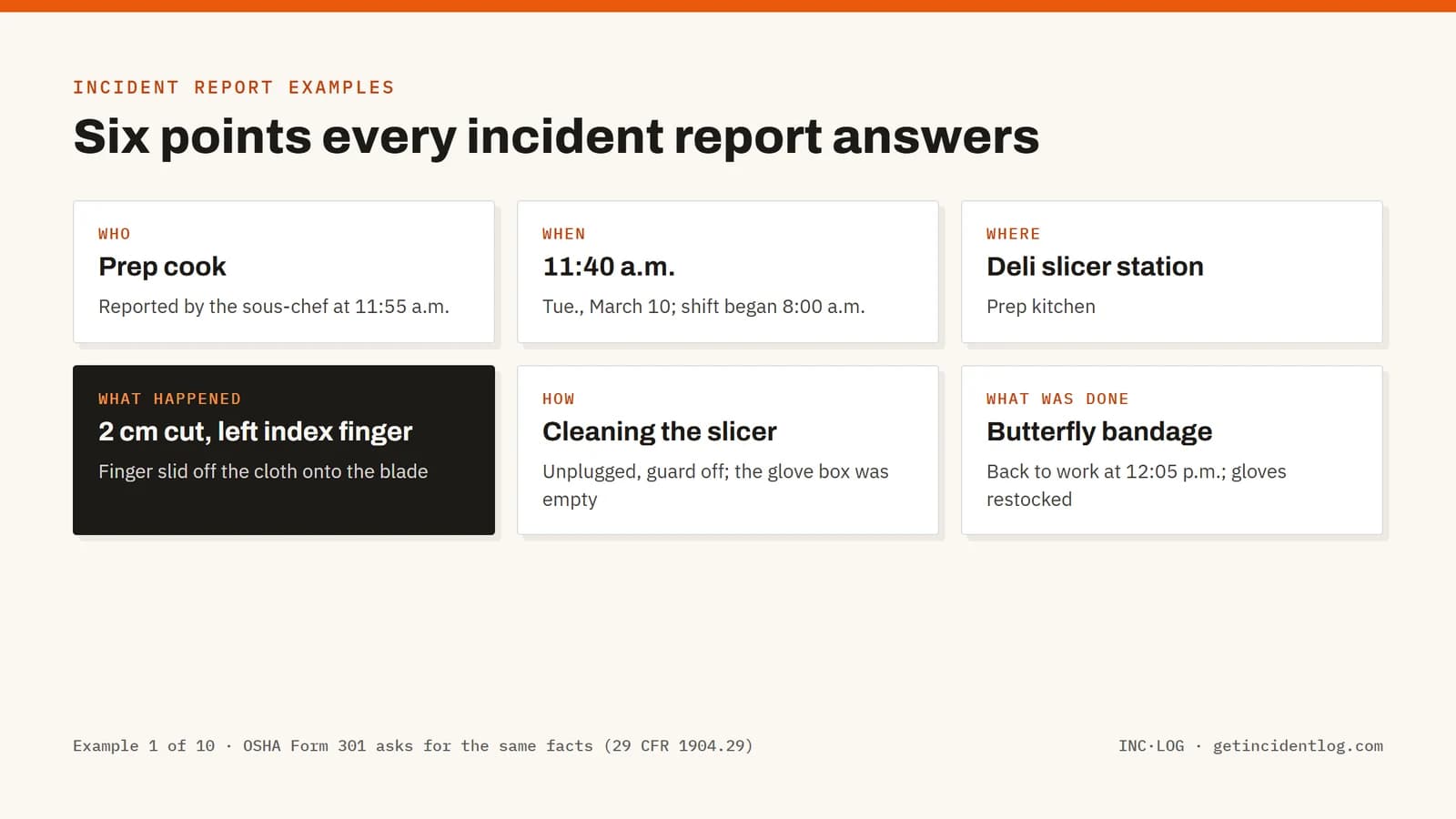
What to include in an incident report
Whatever the form looks like, a complete report answers six questions. For a recordable work injury, OSHA asks for the same facts on its Form 301 incident report, so a report written this way already holds what the employer needs.
| Point | What to write | On OSHA's forms |
|---|---|---|
| Who | The people involved, the witnesses with their contact details, and who is writing the report. | 301 fields 1 to 5 and "completed by" |
| When | The date and the clock time, and when the person's shift began. | 301 fields 11 to 13 |
| Where | The exact spot: "aisle 7, cooler door 4", not "the store". | 300 log, column E |
| What happened | Each step to the injury or damage, then the injury itself: the body part and how it was hurt. | 301 fields 15 and 16 |
| How | What the person was doing just before, with what tool or material, and the object or substance that caused the harm. | 301 fields 14 and 17 |
| What was done | First aid or treatment and where it was given, who was told, photos, and the fix that was started. | 301 fields 6 to 9 |
10 incident report examples
Each one is written the way a supervisor, an officer or the worker would write it the same day. They are invented for this guide: every place, time and person is made up.
- 1. Workplace injury: a cut on a deli slicer
- 2. Slip and fall: a customer in a grocery store
- 3. Near miss: a forklift and a picker in the same aisle
- 4. Security: an aggressive visitor in an office lobby
- 5. Property damage: a box truck hits a dock door
- 6. Vehicle accident: a company van rear-ended
- 7. Chemical spill: floor stripper in a storeroom
- 8. Equipment malfunction: an emergency stop that didn't stop
- 9. Child care: a bite in the toddler room
- 10. Construction: a fall from a stepladder
1. Workplace injury: a cut on a deli slicer
- Date and time
- Tue., March 10, 2026, 11:40 a.m. (shift began 8:00 a.m.)
- Location
- Prep kitchen, deli slicer station
- Person involved
- Prep cook
- Injury
- Cut about 2 cm long, left index finger
- Treatment
- First aid on site: cleaned, butterfly bandage
- Reported by
- Sous-chef, 11:55 a.m.
What happened
At about 11:40 a.m., the prep cook was cleaning the deli slicer after slicing turkey. The slicer was unplugged and the blade guard was off for cleaning. While she wiped the blade from the center toward the edge, her left index finger slid off the cloth onto the blade and was cut, about 2 cm long. I cleaned the cut and closed it with a butterfly bandage from the first-aid kit; the bleeding stopped within five minutes. She did not want to see a doctor and went back to prep at 12:05 p.m. She was not wearing a cut-resistant glove: the glove box at the station was empty. I restocked it and told the kitchen manager.
Why it works: It gives the task, the cause (an empty glove box, not carelessness) and the treatment. A butterfly bandage is first aid, so the case isn't recordable; stitches at a clinic would have made it a recordable case. Form: restaurant kitchen incident report template.
2. Slip and fall: a customer in a grocery store
- Date and time
- Sat., June 6, 2026, 3:15 p.m.
- Location
- Aisle 7, in front of cooler door 4
- Person involved
- Customer (name and phone on the form)
- Injury
- Says her right hip hurts; no visible injury
- Witnesses
- One employee, one customer (contact details on the form)
- Reported by
- Shift supervisor, 3:40 p.m.
What happened
At 3:15 p.m. I heard a fall in aisle 7 and found the customer sitting on the floor in front of cooler door 4. There was a puddle about two feet wide under the door, coming from the base of the cooler. No wet-floor sign was out. She told me she slipped while reaching for milk and landed on her right hip. I offered to call an ambulance and she said no. She stood up with help, sat on a bench for about ten minutes and left with her husband at about 3:35 p.m. Before mopping, I took four photos of the puddle and the cooler base. I put out a cone and opened a maintenance ticket for the cooler drain.
Why it works: It keeps what the supervisor saw (the puddle, no sign) apart from what the customer said (how she fell), and documents the floor before the cleanup, which is what an insurer asks about later. Form: slip and fall incident report template.
3. Near miss: a forklift and a picker in the same aisle
- Date and time
- Wed., April 22, 2026, 6:50 a.m.
- Location
- Warehouse aisle 14, north end
- People involved
- Forklift operator, order picker
- Injury or damage
- None
- Reported by
- Order picker, 7:10 a.m.
What happened
At about 6:50 a.m. I was picking at the north end of aisle 14 when a forklift backed out of the cross aisle toward me. The backup alarm was sounding, but I had earbuds in for the scanner and did not hear it until the forklift was about four feet away. I stepped into the rack bay and the operator stopped. Nobody was hurt and nothing was hit. The convex mirror at that corner is cracked and turned toward the wall, so the operator could not see into the aisle. I told my lead, who taped off the corner until the mirror is replaced.
Why it works: Nobody was hurt, so nothing forces anyone to write this down. The report names two causes someone can fix (the mirror, earbuds that cover the alarm) instead of "be more careful". Form: near miss report template.
4. Security: an aggressive visitor in an office lobby
- Date and time
- Mon., Feb. 9, 2026, 9:05 to 9:25 a.m.
- Location
- Main lobby, front desk
- Person involved
- Male visitor, about 40 (name he gave is on the form)
- Injury or damage
- None; desk phone knocked to the floor, not broken
- Police
- Called 9:12 a.m., arrived 9:21 a.m. (report number on the form)
- Reported by
- Security officer on duty
What happened
At 9:05 a.m. a visitor asked the receptionist to see an employee in accounting. The employee was not expecting him and declined to come down. The visitor raised his voice and said, "I'll wait for her in the parking lot." I asked him twice to leave the building. He swept the desk phone to the floor with his hand and walked out at 9:10 a.m. I called the police at 9:12 a.m. and watched him on the parking lot camera; he drove away at 9:16 a.m. Officers arrived at 9:21 a.m. and took statements. I saved the lobby and parking lot video from 9:00 to 9:20 a.m. and told the employee and her manager.
Why it works: It quotes the threat word for word, puts a time on each step and records the evidence that was kept. "Visitor was hostile" couldn't support a trespass warning; this can. Form: security incident report template.
5. Property damage: a box truck hits a dock door
- Date and time
- Thu., Jan. 15, 2026, 2:30 p.m.
- Location
- Dock door 3
- Vehicle
- Carrier's box truck (carrier and plate on the form)
- Damage
- Bottom two door panels bent; the door won't close
- Injury
- None
- Reported by
- Receiving lead
What happened
At about 2:30 p.m., a carrier's box truck was backing into dock door 3 for a delivery. The overhead door was only about three-quarters open, and the top of the truck's box struck the bottom of the door. The bottom two panels are bent inward and the door no longer closes. No one was hurt. The driver says his box is scratched but not damaged. The dock light that tells drivers the door is fully open has been out since Monday (a maintenance ticket is already open). I took photos of the door and the truck, wrote down the driver's license, plate and carrier details, and closed off door 3 with a chain barrier.
Why it works: It holds what the insurer and the carrier will need (vehicle, plate, the extent of the damage, photos) and the condition behind it, the dock light, which turns a one-off into a fix. Form: property damage report template.
6. Vehicle accident: a company van rear-ended
- Date and time
- Fri., May 8, 2026, 4:20 p.m.
- Location
- Elm St. at 5th Ave., northbound, stopped at a red light
- Vehicles
- Company van #12; the other driver's car (plate and insurance on the form)
- Injury
- Driver reports a stiff neck; went to urgent care at 5:30 p.m.
- Police
- Report number on the form
- Reported by
- Van driver
What happened
At about 4:20 p.m. I was stopped at the red light northbound on Elm St. at 5th Ave. in van #12, on my way back from a service call. A car behind me did not stop and hit the rear of the van. I was wearing my seatbelt. The rear bumper is pushed in and the right rear door won't open. I called the police, who arrived at 4:35 p.m. and wrote a report. The other driver and I exchanged license and insurance information, and I took photos of both vehicles and the intersection. My neck felt stiff after the crash. I called my supervisor at 4:50 p.m. and went to urgent care at 5:30 p.m.
Why it works: First person, in order, with what the police report and both insurers will ask for. The stiff neck and the urgent care visit go in now: the treatment given there decides whether the case goes on the OSHA 300 log. Form: vehicle accident report template.
7. Chemical spill: floor stripper in a storeroom
- Date and time
- Tue., Aug. 18, 2026, 7:15 a.m.
- Location
- Janitorial storeroom B, ground floor
- Substance
- Floor stripper concentrate, about 2 gallons from a 5-gallon pail
- Injury
- None; no one reported symptoms
- Reported by
- Custodian
What happened
At about 7:15 a.m. I opened storeroom B and found floor stripper on the floor around the bottom shelf, about 2 gallons spread over roughly 4 by 6 feet. The 5-gallon pail on the bottom shelf had a crack near its base. The room had a strong chemical smell. I closed the door, put a sign on it and called my supervisor. Following the safety data sheet, we put on gloves and goggles, turned on the exhaust fan, soaked up the liquid with spill pads and bagged them for disposal. Nothing reached the floor drain. No one had symptoms. The cracked pail was moved into a containment tray.
Why it works: It names the product and the amount, follows the safety data sheet step by step, and says whether anything reached a drain, which decides whether the spill goes further than an internal report. Form: chemical spill report template.
8. Equipment malfunction: an emergency stop that didn't stop
- Date and time
- Mon., Sept. 14, 2026, 6:05 a.m.
- Location
- Packing line 2, conveyor C2
- Equipment
- Emergency stop button #3
- Injury
- None
- Action
- Conveyor locked out and tagged; repaired and retested
- Reported by
- Line lead
What happened
At about 6:05 a.m., during the start-of-shift check on packing line 2, I pressed emergency stop #3 on conveyor C2 and the belt kept running. Stops #1 and #2 stopped it normally. I stopped the line from the main panel, locked out and tagged the conveyor, and called maintenance at 6:10 a.m. The maintenance tech found a loose wire at button #3 and repaired it at 7:20 a.m. We tested all three stops twice before restarting the line at 7:35 a.m. No one was hurt and no product was lost.
Why it works: The kind of report that prevents an injury: what was tested, what failed, how the line was made safe, and how the repair was checked before the restart. Form: equipment malfunction report template.
9. Child care: a bite in the toddler room
- Date and time
- Thu., Nov. 5, 2026, 10:25 a.m.
- Location
- Toddler room, block area
- Children involved
- Child A (bitten) and Child B (initials on the form)
- Injury
- Red bite mark, right forearm; skin not broken
- First aid
- Washed with soap and water, cold pack for 5 minutes
- Reported by
- Lead teacher
What happened
At about 10:25 a.m., Child A and Child B were playing in the block area. Both reached for the same truck and Child B bit Child A on the right forearm. I was about six feet away and saw it. The bite left a red mark; the skin was not broken. I washed the area with soap and water and held a cold pack on it for five minutes. Child A cried for about two minutes and went back to playing. I talked with Child B about gentle hands. I called both families by 11:00 a.m. without telling either one the other child's name, and both parents signed this report at pickup.
Why it works: Initials instead of names, the injury described exactly (whether the skin is broken matters for a bite), and both families told without naming the other child. Form: daycare incident report form.
10. Construction: a fall from a stepladder
- Date and time
- Tue., July 21, 2026, 1:50 p.m. (shift began 7:00 a.m.)
- Location
- Building B, second floor, unit 204
- Person involved
- Electrician
- Injury
- Fractured left wrist, diagnosed at the emergency room
- Treatment
- Emergency room, cast; not admitted overnight
- Witness
- Drywall finisher in the same unit
What happened
At about 1:50 p.m., the electrician was on a 6-foot stepladder in unit 204, pulling wire through the ceiling. The ladder was set up on a loose sheet of drywall scrap. When he leaned to his right, the scrap slid and the ladder tipped. He fell about 5 feet onto his left hand. The drywall finisher working in the same unit saw the fall and called me. His wrist was swollen and he could not move it. I drove him to the emergency room at 2:10 p.m., where an X-ray showed a fractured left wrist. It was put in a cast and he went home that evening. I had the drywall scrap cleared from every unit on that floor.
Why it works: This one is recordable: a fracture diagnosed by a doctor, treated beyond first aid. The employer enters it on the OSHA 300 log and completes Form 301 within 7 calendar days, and this report already answers its fields 14 to 17. Form: construction incident report template.
Vague or specific: the same facts, written twice
Most weak reports aren't wrong, just vague. Each line on the left is a sentence a reviewer, an insurer or OSHA can do nothing with; the line next to it is the same fact from the examples above.
Instead ofEmployee hurt her hand.
WriteCut about 2 cm long on the left index finger.
Form 301 asks for "the part of the body that was affected and how it was affected".
Instead ofIt happened this afternoon.
WriteAt about 3:15 p.m.
Form 301 asks for the time of the event and the time the employee began work.
Instead ofHe was careless.
WriteThe ladder was set up on a loose sheet of drywall scrap, which slid when he leaned.
OSHA warns against putting an incident down to carelessness alone (below).
Instead ofThe floor was wet.
WriteA puddle about two feet wide under cooler door 4, coming from the cooler's base. No wet-floor sign was out.
Where, how much, where it came from and what was missing.
Instead ofShe slipped on milk she spilled.
WriteShe told me she slipped while reaching for milk.
The writer didn't see the fall, so the report says whose account it is.
Instead ofThe visitor was hostile.
WriteHe said, "I'll wait for her in the parking lot," and swept the desk phone to the floor.
Words and actions, not a label.
Instead ofProblem fixed.
WriteCone placed; maintenance ticket opened for the cooler drain.
What was done, and who owns the fix.
On blame, OSHA's guidance on incident investigations is blunt:
"It is far too easy, and often misleading, to conclude that carelessness or failure to follow a procedure alone was the cause of an incident. To do so fails to discover the underlying or root causes of the incident."
The examples above do the same: an empty glove box, a cracked mirror, a burnt-out dock light. Each is a cause someone can fix by Friday.
How to write an incident report
- Take care of people and make the area safe. First aid or a call to 911 comes first, then whatever stops it from happening to the next person: a cone over the spill, the machine locked out, the area roped off.
- Write it the same day. Write it before the end of the shift, while the details are fresh. For a recordable work injury, OSHA requires the Form 301 details within 7 calendar days, and a death or severe injury is reported to OSHA within 8 or 24 hours.
- Record who, when and where. Date, clock time, the exact spot ("cooler door 4, aisle 7", not "the store"), the people involved, witnesses and their contact details, and who is writing the report.
- Tell what happened, in order. Start with what the person was doing just before, then each step to the injury or damage, in the past tense and plain words. Name the body part and the injury, and the object that caused it.
- Keep facts apart from opinions. Write what you saw, and mark what others told you as theirs. Leave out blame: OSHA warns that putting an incident down to carelessness alone misses the root cause.
- Add what was done and sign it. First aid or treatment, who was notified, photos taken before the cleanup, and the fix that was started. Sign and date the report, and keep it with the witness statements.
The workplace injury incident report template has these fields in a printable PDF or Word file, and the template library has one for each kind of incident above.
When an incident report becomes an OSHA record
Most incident reports stay inside the company. A work injury becomes an OSHA record when it goes beyond first aid:
- First aid only (a bandage, a butterfly bandage, a cold pack): not recordable, as in the deli slicer example. Keep the incident report.
- Recordable (medical treatment beyond first aid, days away, restricted work, a fracture diagnosed by a doctor): the case goes on the OSHA 300 log, with a Form 301 or an equivalent form, within 7 calendar days (29 CFR 1904.29), as in the stepladder example.
- Severe: a work-related death is reported to OSHA within 8 hours, and an in-patient hospitalization, an amputation or the loss of an eye within 24 hours (29 CFR 1904.39).
The OSHA recordable injury checker walks through the test, and the OSHA 300 log guide covers what to do with a recordable case. A report about something that nearly happened is a near miss: what a near miss is, with 30 examples.
Frequently asked questions
How do you write an incident report?
Make the area safe, then write the report the same day: the date and clock time, the exact location, the people involved and the witnesses, what the person was doing just before, what happened step by step, the injury or damage, and what was done right away. Stick to what you saw, keep blame out, and sign and date it.
What are the 6 points that should be included in an incident report?
Who was involved (and who saw it), what happened, when it happened, where, how it happened (what the person was doing and what caused the injury or damage), and what was done about it (first aid, notifications, the fix). OSHA's Form 301 asks for the same facts for a recordable injury, down to the time the employee began work.
Can you give me an example of an incident report?
"At about 11:40 a.m., the prep cook was cleaning the deli slicer, unplugged, with the blade guard off. Her left index finger slid off the cloth onto the blade and was cut about 2 cm. The sous-chef cleaned it and closed it with a butterfly bandage; she did not see a doctor. The box of cut-resistant gloves at the station was empty."
How do you write an incident report for work?
Use your employer's form if there is one, or a template with the same fields. Write in the past tense, in the first person if you were there, with clock times. Describe the task, the event, the injury or damage and the treatment. Your employer uses it for the OSHA 300 log and Form 301 if the injury turns out to be recordable.
What should you not write in an incident report?
Guesses written as facts, blame ("he was careless"), opinions about who should be disciplined, and medical diagnoses you aren't qualified to make. Write what you saw and mark the rest as what someone told you. On OSHA Form 301, the fields that describe the event (14 to 17) should not hold workers' names, phone numbers or Social Security numbers.
How soon should an incident report be written?
The same shift, or the same day at the latest: memories and the scene change fast. OSHA sets the outer limits for recordable work injuries: the Form 301 details within 7 calendar days, and a report to OSHA within 8 hours of a work-related death or within 24 hours of an in-patient hospitalization, an amputation or the loss of an eye.
Sources read on October 15, 2026: OSHA's Form 301 (Rev. 04/2004) and 300 log in the recordkeeping forms package, OSHA's incident investigation page, and 29 CFR Part 1904. IncidentLog is not affiliated with OSHA.
Get the report written where it happened
With IncidentLog, a QR poster at the site opens the report form on the worker's own phone, in English or Spanish, with no app and no account: when it happened, what happened, the injury and photos, signed. A recordable case lands on your OSHA 300 log, and its Form 301 starts from what the worker wrote.