What Is a Near Miss? Definition and 30 Examples at Work
A near miss is an unplanned event that could have hurt someone or damaged something, but didn't: a load that slips off the forks and is set down in time, a worker who steps back from an unguarded edge just before falling. OSHA's construction guidance defines a close call or near miss as "an incident that could have, but did not, result in death, injury, or illness." A near miss isn't recorded on the OSHA 300 log, since nobody was hurt, but OSHA counts the number of near misses reported as a leading indicator of a safety program, because the hazard behind it is still there until someone fixes it.
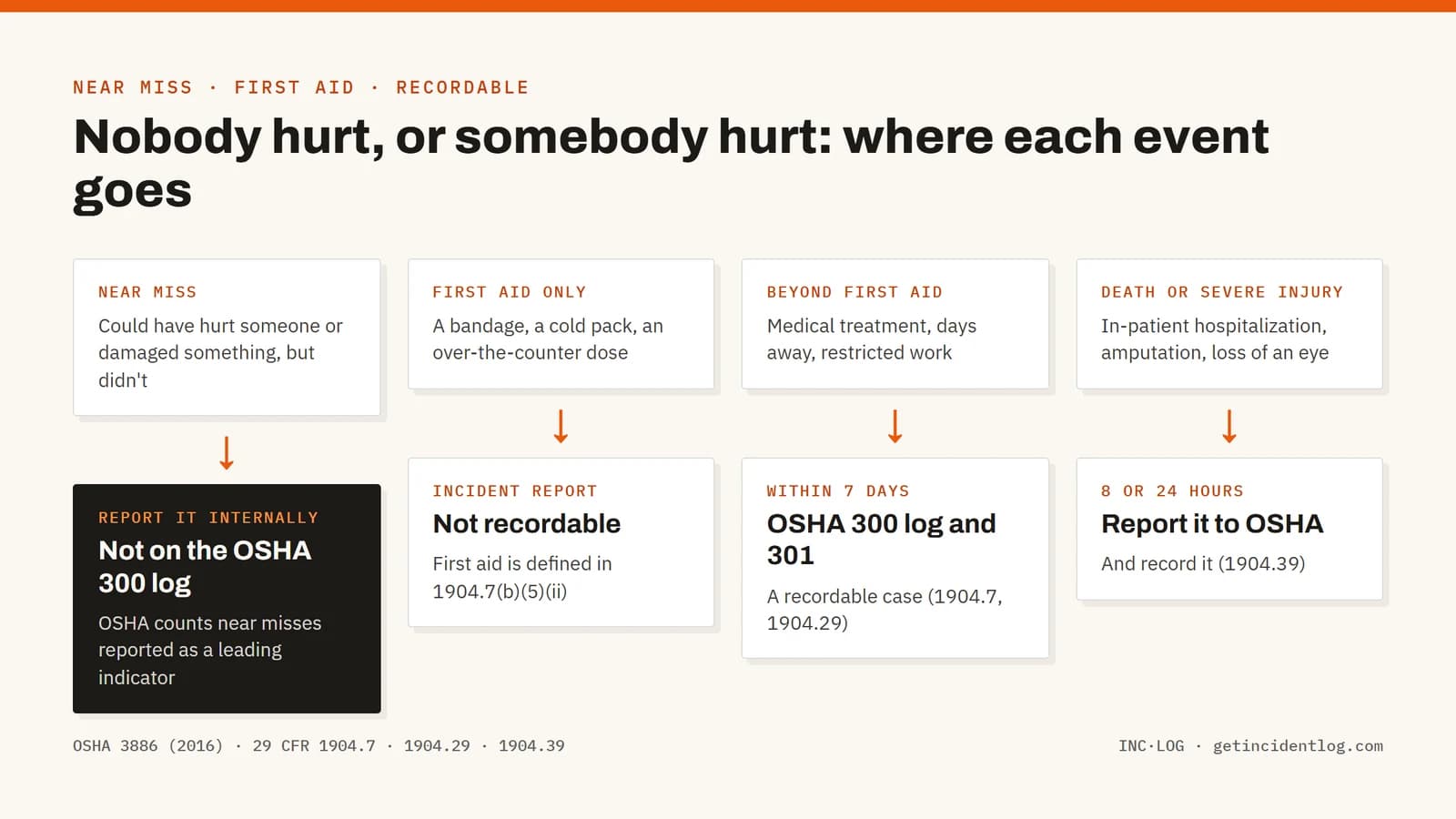
Near miss definition, in OSHA's words
OSHA defines it in two of its own documents:
"Close call/near miss: An incident that could have, but did not, result in death, injury, or illness."
"A close call or narrow escape, an unintentional incident that could have resulted in human injury, illness, environmental or equipment damage, or an interruption to normal operation."
In practice: if anyone needed a bandage, it wasn't a near miss, it was an incident. If nobody was hurt and nothing was damaged, but a step to the left or a second later would have changed that, it was a near miss.
30 near miss examples, by workplace
Each of these could have hurt someone, and none did. They are illustrations, written for this guide.
Construction sites
- A pallet of block shifts on the forks of a telehandler and is set down before it tips.
- A worker steps back toward an unguarded floor opening, and a coworker shouts in time.
- A hammer falls from the third level into the barricaded area, with no one below.
- A trench wall sloughs overnight, and the crew sees it before anyone climbs in.
- An excavator swings within a few feet of a laborer walking behind it.
Warehouses and loading docks
- A trailer creeps away from the dock as a forklift starts in, and the driver brakes in time.
- A forklift backs out of an aisle and stops a few feet short of a picker.
- A carton falls off the top of a rack into an empty aisle.
- A dock plate that isn't seated shifts under someone's foot, without a fall.
- Shrink wrap on the floor makes someone slip, and they catch themselves on a rack.
Manufacturing and maintenance
- A machine guard is found removed at shift change, before the next run.
- A mechanic's hand is near the die when the press is cycled, and the light curtain stops it.
- Lockout is skipped on a conveyor, and someone notices before reaching in.
- A grinding wheel turns out to be cracked during the pre-use check.
- A hydraulic hose leaks onto a walkway, and it's cleaned up before anyone walks through.
Restaurants and kitchens
- A pan of fryer oil starts to tip off the edge of the stove and is caught.
- A knife left under the sink water is spotted before the dishwasher reaches in.
- The walk-in cooler door sticks for a moment with a cook inside.
- A bleach cleaner is about to be mixed with an ammonia cleaner, and someone stops it.
- A server slides on a wet floor by the dish station, with no sign out, and doesn't fall.
Offices and retail stores
- Someone trips on a cable across a walkway and catches the desk.
- A box falls off the top stockroom shelf right after an employee steps away.
- A space heater is found pushed against a stack of paper.
- A step stool missing a foot wobbles before anyone climbs it.
- A customer nearly backs a cart into an employee standing on a ladder.
Vehicles and yards
- A delivery van backs out without a spotter and stops short of a pedestrian.
- A truck's brakes feel soft on the pre-trip check, and it's taken out of service.
- Two vehicles nearly collide at a blind corner of the parking lot.
- A load strap snaps on a flatbed in the yard, and nothing falls.
- A driver nods off for a second and the lane departure warning wakes them.
What a near-miss reporting system collects
The near-miss reporting policy template OSHA publishes (produced under an OSHA grant) lists six kinds of event to report, including minor incidents that could have been worse:
- Unsafe conditions
- A missing guardrail, a blocked exit, a leak on a walkway.
- Unsafe behavior
- A worker modifying personal protective equipment for comfort.
- Minor incidents that could have been worse
- A scrape from a falling object that could have hit someone's head.
- Events where someone could have been hurt
- A forklift and a picker in the same aisle, stopped in time.
- Events where property or the environment could have been damaged
- A tank that nearly overflows, a load that nearly drops.
- Events where a safety barrier was challenged
- A worker bypassing a machine guard.
Near miss, first aid or recordable: what goes where
| Event | Where it goes | What happened |
|---|---|---|
| Near miss | Your near-miss or incident log; not the OSHA 300 log | Nobody hurt, nothing damaged, but it could have been |
| First-aid case | An incident report; not recordable | A minor injury treated with first aid only (29 CFR 1904.7(b)(5)(ii)) |
| Recordable case | The OSHA 300 log and a Form 301 within 7 calendar days | Medical treatment beyond first aid, days away, restricted work, and other criteria in 1904.7 |
| Severe injury | Reported to OSHA within 8 or 24 hours (1904.39), and recorded | A death, an in-patient hospitalization, an amputation or the loss of an eye |
Not sure whether an injury is recordable? The OSHA recordable injury checker walks through the test, and the OSHA 300 log guide covers what to do with a recordable case.
Why near misses are worth reporting
A near miss is a free warning: the hazard showed itself without hurting anyone. OSHA's construction guidance asks employers to set up a simple way for workers to report near misses "without fear of retaliation", to investigate them, and to track the number of hazards, near misses and first-aid cases reported as a leading indicator, a measure of the safety program that moves before injuries do.
Most go unreported for the same reason: nothing happened, so nothing forces anyone to write it down, and the form is in the trailer. Why that is, and the tools that fix it, are in near miss reporting software and apps compared.
How to report a near miss
- Make the area safe first. Stop the work, barricade the spot or take the equipment out of service so the same thing can't happen to the next person while the report is being written.
- Report it the same shift. Report it while the details are fresh. A near-miss reporting policy template produced under an OSHA grant asks employees to report within 24 hours.
- Write down the facts. What almost happened, where and when, what made it possible (the condition or the action), and what was done right away. A photo of the hazard, if it's safe to take one, says more than a paragraph.
- Find the cause and fix it. Someone reviews the report, finds why it happened (a missing guard, a blocked aisle, a step that gets skipped) and assigns a correction with a date, not only a reminder to be careful.
- Tell the crew what changed. Share the fix at the next toolbox talk or on the board. People keep reporting near misses when they see reports lead to changes.
The free near miss report template covers these points, as a printable PDF or Word file.
Frequently asked questions
What is a near miss?
A near miss is an unplanned event that could have caused injury, illness or damage but didn't, because of timing, distance or a last-second correction. Nobody was hurt and nothing was damaged this time, but the hazard that almost caused harm is still there. It's also called a close call, and some companies call a reported one a good catch.
What is OSHA's definition of a near miss?
OSHA's Recommended Practices for Safety and Health Programs in Construction (OSHA 3886) define a close call or near miss as "an incident that could have, but did not, result in death, injury, or illness." OSHA's own field safety manual adds equipment or environmental damage and interruptions to normal operation to what a near miss could have caused.
What is the difference between a near miss and an incident?
In an incident, someone was hurt or something was damaged; in a near miss, neither happened. A worker who cuts a finger and gets a bandage was in an incident, not a near miss, even though a first-aid-only injury isn't recorded on the OSHA 300 log. A box that falls into an empty aisle is a near miss.
Do near misses have to be reported to OSHA?
No. OSHA's recordkeeping rule, 29 CFR Part 1904, covers work-related injuries and illnesses, and the 8- and 24-hour reports cover deaths and severe injuries. Near misses are reported inside the company. OSHA recommends a simple system for workers to report them without fear of retaliation, and counts the number reported as a leading indicator.
What are some examples of a near miss?
A forklift backs out of an aisle and stops a few feet short of a picker. A hammer falls from a scaffold into a barricaded area with no one below. Fryer oil tips toward the edge of the stove and is caught. A delivery van backs out without a spotter and stops short of a pedestrian. Each could have hurt someone, and none did.
Should near misses be reported anonymously?
Allowing it helps where workers fear blame. OSHA's construction guidance asks for reporting without fear of retaliation, and a near-miss policy template produced under an OSHA grant says the system won't lead to discipline and can be anonymous if the reporter wants. What matters most is that reports lead to fixes people can see.
Sources read on osha.gov on October 15, 2026: OSHA 3886 (2016), the Field Safety and Health Management System Manual (chapter 2) and the near-miss reporting policy template; rules from 29 CFR Part 1904. IncidentLog is not affiliated with OSHA.
Report a near miss from where it happened
With IncidentLog, a QR poster at the site opens the report form on the worker's own phone, in English or Spanish, with no app and no account. Near misses land in the same log as incidents, across your sites, so a hazard that keeps coming back shows up before it hurts someone.