Near Miss Incident Report Template
Free PDF and Word · Updated
A near-miss report documents an incident that almost happened (a fall narrowly avoided, an equipment failure caught in time) before it becomes an actual accident, and is the foundation of proactive HSE risk prevention programs.
Near-miss reporting is a cornerstone of HSE prevention. This template makes it easy to report quickly, so you can identify root causes before a real accident happens.
What this template includes
Every field below is part of the free template and the mobile version; nothing is locked behind a paywall for filling out a single report.
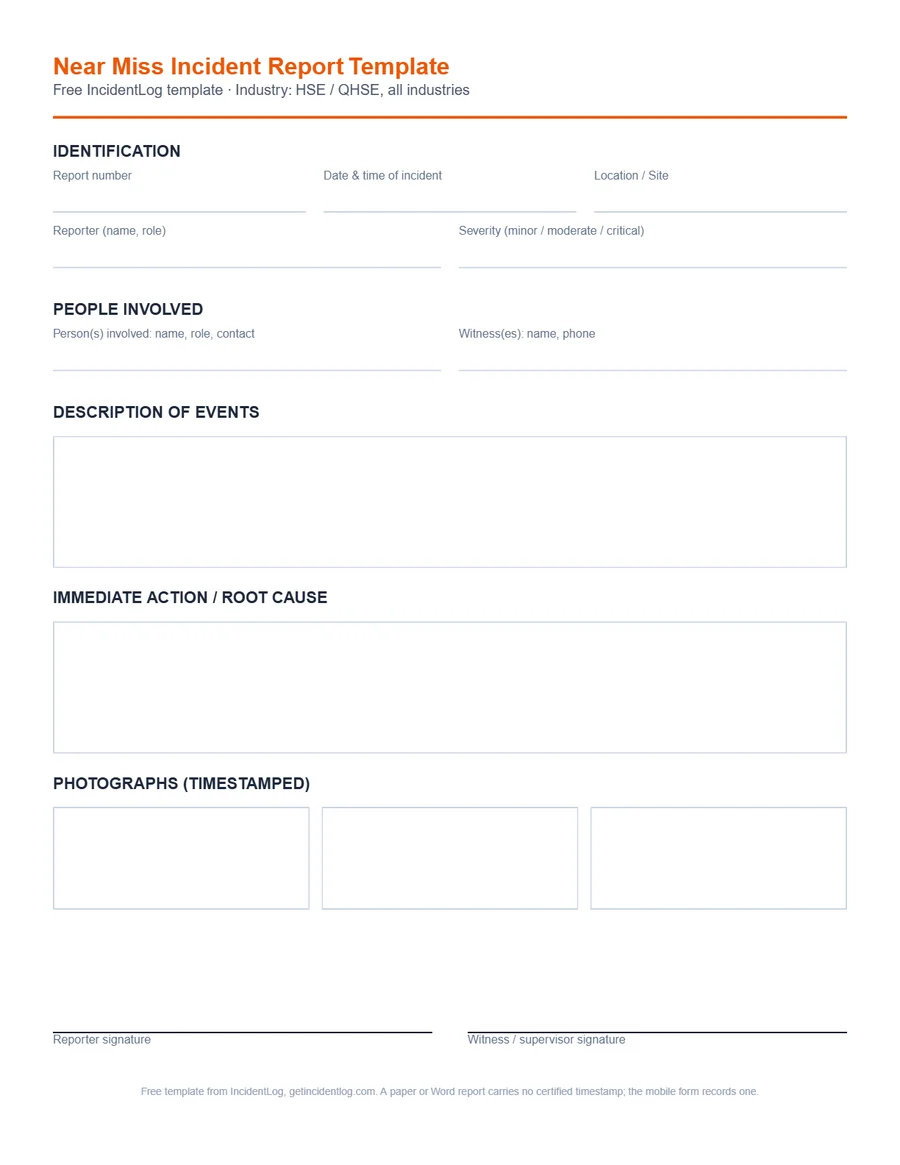
- Report number and date/time of the incident
- Location or site
- Reporter's name and role
- Severity (minor, moderate, or critical)
- Person(s) involved: name, role, contact
- Witness(es): name, phone
- Description of events
- Immediate action taken and root cause (if known)
- Up to 3 timestamped photographs
- Reporter signature
- Witness or supervisor signature
How to file a defensible hse / qhse, all industries report
- 1
Report it even though nothing happened
The whole value of a near miss is reporting it before it becomes an accident: don't wait for an actual injury to justify filing.
- 2
Describe what almost went wrong
Record exactly what nearly happened and the conditions that made it possible: the specifics are what make the report useful for prevention.
- 3
Flag the root cause
Use the root-cause field to identify the underlying condition, not just the immediate trigger, so it can actually be fixed.
- 4
Track trends across your log
A centralized near-miss log lets you spot the same risk recurring across sites or shifts before it results in a real accident.
Common use cases
- Fall narrowly avoided
- Equipment failure caught in time
- Risky behavior observed
- Near-collision between a vehicle and a pedestrian
Near miss vs. actual incident
| Situation | Near miss | Actual incident |
|---|---|---|
| Outcome | No injury, no damage: avoided at the last moment | Injury, damage, or loss occurred |
| Why report it | Identifies a risk before it causes harm | Documents harm that already happened |
| Typical example | A load nearly fell but was caught / stabilized in time | A load fell and caused injury or damage |
| Urgency | Preventive: fix the condition now | Reactive: respond, treat, and then prevent recurrence |
Frequently asked questions
Why encourage near-miss reporting?
Every reported near miss is an opportunity to fix a risk before it causes a real accident. A centralized log helps you spot recurring trends by site or activity type.
How do you fill out a near miss report?
Write what almost happened, where and when, what made it possible (a missing guard, a wet floor, a blind corner), and what was done about it right away. Add a photo if it's safe to take one. Keep it short enough to finish on the spot; a near-miss form that takes ten minutes doesn't get filled in.
What is a good example of a near miss?
A pallet sliding off a forklift and landing a few feet from a worker; a ladder that wobbles because one foot is on a cord; a car backing out of a bay just as someone walks behind it. In each case nobody was hurt, but the same conditions can hurt someone next time.
Do near misses have to be reported?
OSHA doesn't require it: its recordkeeping rule covers injuries and illnesses, not near misses. Many companies make near-miss reporting part of their safety program because it's the cheapest way to find a hazard before it injures someone.
For the federal recordkeeping rules referenced above, see OSHA's recordkeeping requirements.
Related reading
Near Miss Reporting Software and Apps: 7 Options Compared (2026)
Near miss reporting software and apps compared on price, QR reporting and sign-in: IncidentLog, Mitti, Safesite, VelocityEHS, EHS Insight and free forms.
Compliance guideWhat Is a Near Miss? Definition and 30 Examples at Work
What a near miss is, in OSHA's own words, with 30 examples from construction sites, warehouses, kitchens and offices, and how it differs from an incident.
Go digital: signature, photos, and archiving included
The Pro plan at $49/mo includes OSHA 301 export, 5-year legal archiving, and unlimited users on 1 site.
See pricing