Workplace Injury Incident Report Template & Sample
Free PDF and Word · Updated
A workplace injury report documents any employee injury with the date, severity, medical treatment received, and days away from work: the information OSHA requires within 7 days of a recordable incident, and the basis for the employer's OSHA 300 log.
Every workplace injury needs to be documented for OSHA compliance, your liability insurer, and HR tracking. This template covers severity, medical treatment, and days away from work.
What this template includes
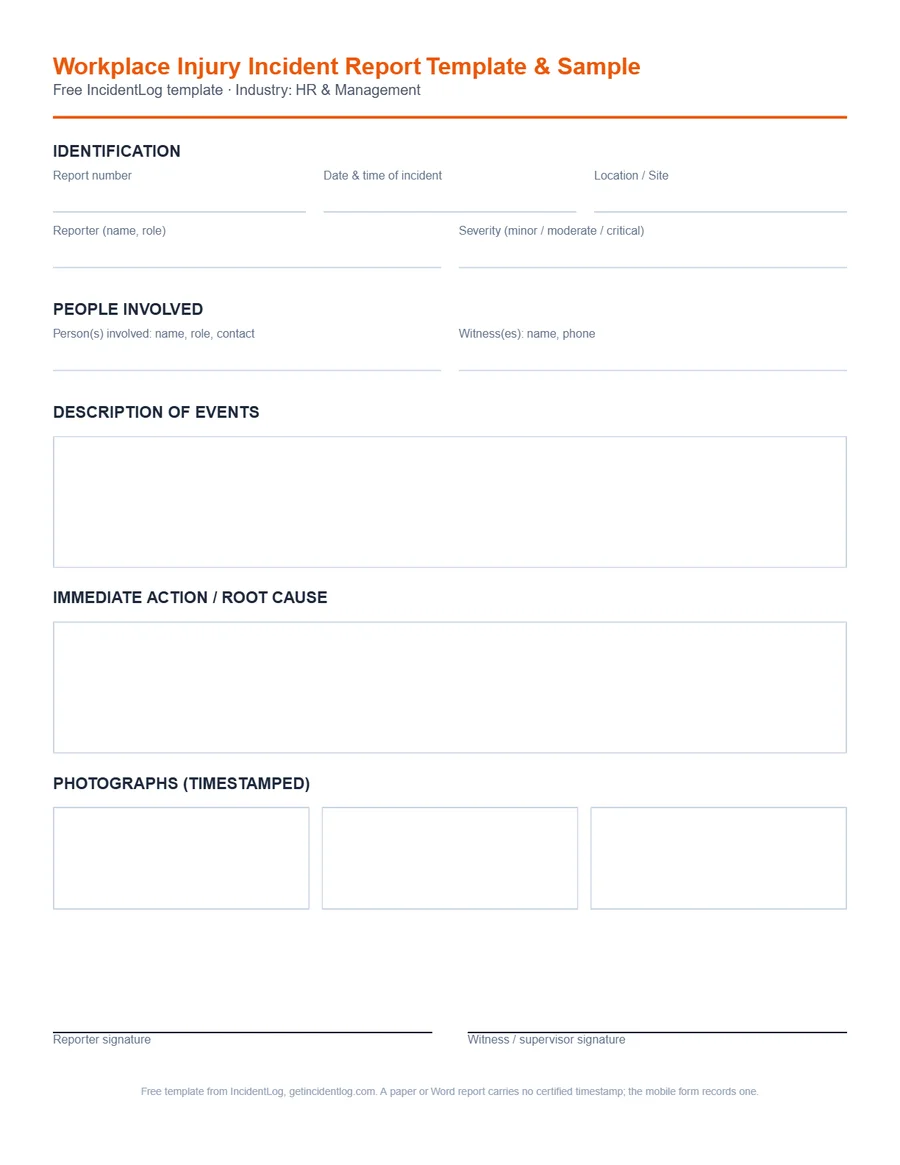
Every field below is part of the free template and the mobile version; nothing is locked behind a paywall for filling out a single report.
- Report number and date/time of the incident
- Location or site
- Reporter's name and role
- Severity (minor, moderate, or critical)
- Person(s) involved: name, role, contact
- Witness(es): name, phone
- Description of events
- Immediate action taken and root cause (if known)
- Up to 3 timestamped photographs
- Reporter signature
- Witness or supervisor signature
Sample completed report
What this template looks like filled in. Every name, place and time below is invented.
- Report number
- INC-2026-0031
- Date and time of incident
- Tuesday, April 14, 2026, 10:20 a.m.
- Location
- Packing line 2, warehouse floor
- Reported by
- D. Okafor, line supervisor
- Severity
- Moderate
- Injured employee
- T. Ruiz, packer
- Witness
- A. Patel, packer at the next station
- Injury and treatment
- 2 cm cut to the left palm; first aid on site, then 3 stitches at urgent care
- Work status
- Returned to regular duty the next day
- OSHA recordable
- Yes: stitches are medical treatment beyond first aid (29 CFR 1904.7(b)(5))
Description of events
At about 10:20 a.m., T. Ruiz was cutting strapping on a pallet with a box cutter when the blade slipped and cut the palm of the left hand. A. Patel, at the next station, saw it and called me. I applied pressure with gauze from the line first-aid kit and the bleeding slowed. Because the cut was deep, I drove T. Ruiz to the urgent care clinic at 10:45 a.m., where it was closed with three stitches. The cutter in use had a fixed blade; the line's safety-blade cutters had run out. Corrective action: safety cutters restocked the same afternoon and fixed-blade cutters removed from line 2.
More filled-in reports, one per kind of incident: 10 incident report examples.
How to file a defensible hr & management report
- 1
Record the injury the same day
Note the date, time, exact location, and what the employee was doing when it happened. OSHA gives you 7 calendar days to file Form 301, but same-day notes are far more accurate.
- 2
Capture the OSHA-relevant details
Record whether medical treatment beyond first aid was given, whether the employee lost consciousness, and how many days away from work or on restricted duty resulted: these determine if the case is OSHA-recordable.
- 3
Collect signatures
Get the reporter's signature and, where possible, a witness or supervisor signature to corroborate the account.
- 4
Roll it into your OSHA 300 log
Each individual report should feed your annual OSHA 300 log, so recordable cases are already tracked when it's time to post the 300A summary.
Common use cases
- Slip, trip, or fall
- Machine or tool-related injury
- Musculoskeletal disorder
- Injury requiring medical care
First aid vs. OSHA recordable
| Situation | First aid only | OSHA recordable |
|---|---|---|
| Treatment given | Bandage, ice, over-the-counter medication at non-prescription strength | Prescription medication, stitches, or treatment beyond first aid |
| Work impact | Employee returns to full duty immediately | Days away from work, restricted duty, or job transfer |
| Consciousness | No loss of consciousness | Loss of consciousness |
| Outcome | Minor, no lasting effect | Death, significant injury, or illness diagnosed by a physician |
Frequently asked questions
What makes an incident "OSHA recordable"?
Per OSHA recordkeeping rules, an incident is recordable if it results in death, loss of consciousness, days away from work, restricted duty or job transfer, or medical treatment beyond first aid.
What's the difference between OSHA Form 300 and 301?
OSHA Form 300 is the running annual log of all recordable injuries and illnesses at a site. OSHA Form 301 is the detailed incident report filled out for each individual case, within 7 calendar days of learning about it.
How soon does a workplace injury have to be reported?
Inside the company, right away: most state workers' comp laws give the employee a deadline to tell the employer (30 days in California). For OSHA, a recordable case goes on the 300 log within 7 calendar days (29 CFR 1904.29), and a death must be reported to OSHA within 8 hours, an in-patient hospitalization, amputation or loss of an eye within 24 hours (1904.39).
Can this template replace OSHA's Form 301?
Not on its own. The 301 asks for details this general report doesn't, such as the employee's date of birth and hire date, the physician and treatment facility, and whether they went to an emergency room or stayed overnight. Use OSHA's 301 or an equivalent form for recordable cases; the OSHA 300 log form page links to the official forms.
For the federal recordkeeping rules referenced above, see OSHA's recordkeeping requirements.
Related reading
OSHA 300 log and 300A forms: free printable PDFs
When an injury is recordable it goes on the OSHA 300 log within 7 days: the blank log, and how to fill in each column.
Compliance guideOSHA 300 Log: Requirements, Posting Deadline, and How It Differs From the 300A
What the OSHA 300 log is, how it differs from the 300A and 301, when the 300A must post (Feb 1–Apr 30), and who has to submit data electronically.
Compliance guideIncident Report Examples: 10 Written Samples and How to Write One
10 written incident report examples (injury, slip and fall, near miss, security, vehicle, spill), what every report needs, and how to write one at work.
Guía en españolReporte de Accidentes de Trabajo: Cómo Hacerlo y Cuánto Tiempo Tienes
Guía sobre cómo reportar un accidente de trabajo y los plazos reales: el plazo OSHA del empleador es distinto al del empleado, que varía por estado.
Guía en españolFormulario OSHA 300: Qué Es, Cuándo Se Publica y En Qué Se Diferencia del 300A
Qué es el formulario OSHA 300, en qué se diferencia del 300A y el 301, cuándo debe publicarse (1 feb–30 abr), y qué empleadores deben enviarlo a OSHA.
Go digital: signature, photos, and archiving included
The Pro plan at $49/mo includes OSHA 301 export, 5-year legal archiving, and unlimited users on 1 site.
See pricing