OSHA Form 301: Free Printable Incident Report and How to Fill It Out
OSHA Form 301, the Injury and Illness Incident Report, records the details of one recordable work injury or illness: who was hurt, where they were treated, and what happened. Covered employers complete one for each case on the OSHA 300 log within 7 calendar days of learning about it, and keep it for 5 years (29 CFR 1904.29 and 1904.33). Download a blank, printable 301 below, or use an equivalent form, such as a workers' compensation first report of injury, if it holds the same information.
Download the form
- Our blank 301 has OSHA's 18 fields in the same three sections, on one US Letter page with room to write. Free, no email asked.
- OSHA's official package has the 301 with the 300 and 300A, as a fillable PDF, and en español.
- The 300 log and the 300A: printable OSHA 300 and 300A forms.
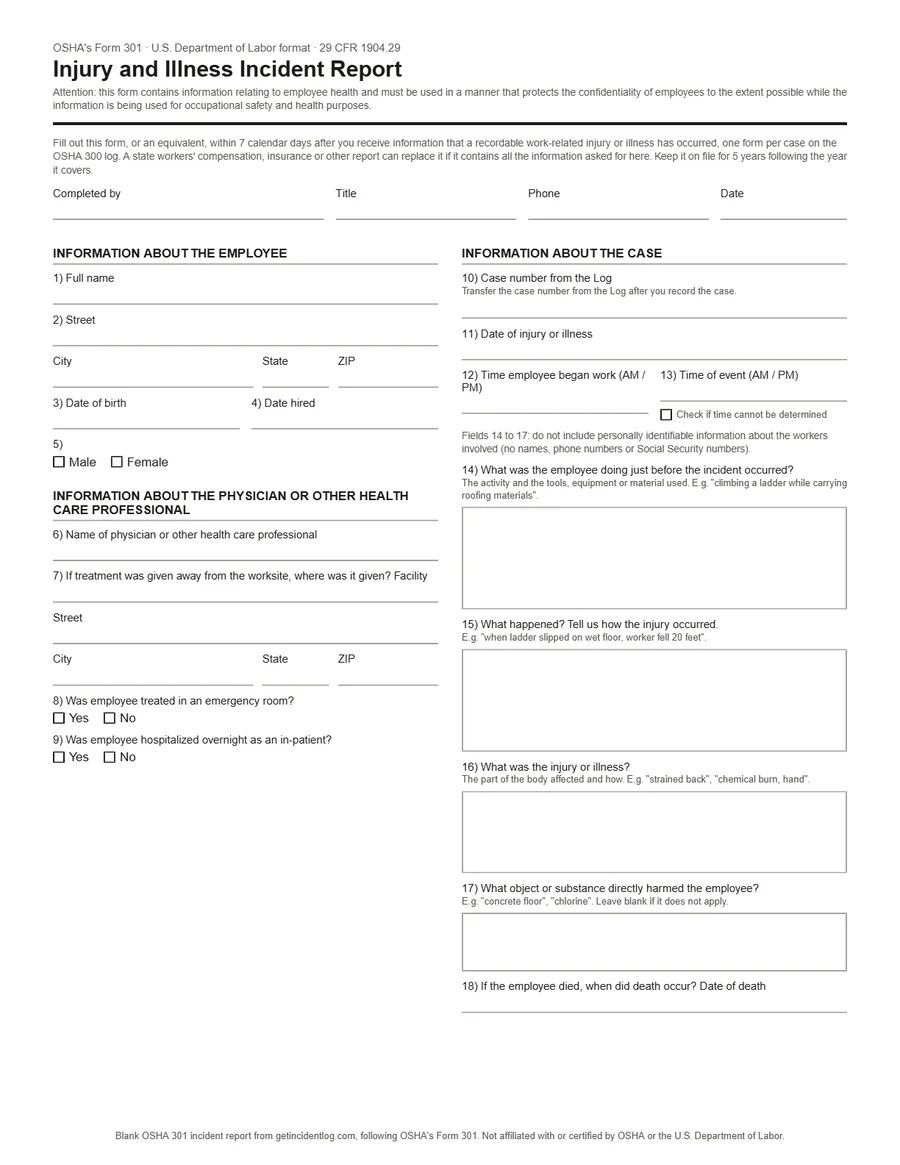
How to fill out OSHA Form 301, field by field
Fill one out for each case on the 300 log. Fields 14 to 17 describe what happened: OSHA asks that they hold no names, phone numbers or Social Security numbers of the workers involved. If you aren't sure the case is recordable, the OSHA recordable injury checker walks through the test.
Information about the employee
- 1) Full name
- The employee's full name.
- 2) Street, city, state, ZIP
- The employee's home address.
- 3) Date of birth and 4) Date hired
- Month, day and year for each.
- 5) Male or female
- One check.
Information about the physician or other health care professional
- 6) Name of physician or other health care professional
- Who treated the employee, if anyone did.
- 7) Where treatment was given
- The facility and its address, if treatment was given away from the worksite.
- 8) Treated in an emergency room?
- Yes or no.
- 9) Hospitalized overnight as an in-patient?
- Yes or no. An in-patient hospitalization also has to be reported to OSHA within 24 hours (29 CFR 1904.39).
Information about the case
- 10) Case number from the Log
- The same number as the case's line in column A of the OSHA 300 log.
- 11) Date of injury or illness
- Month, day and year.
- 12) Time employee began work
- Hour and minute, AM or PM.
- 13) Time of event
- Hour and minute, or check the box if it can't be determined.
- 14) What was the employee doing just before?
- The activity and the tools, equipment or material used, e.g. "climbing a ladder while carrying roofing materials".
- 15) What happened?
- How the injury occurred, e.g. "when the ladder slipped on the wet floor, the worker fell 20 feet".
- 16) What was the injury or illness?
- The part of the body and how it was affected, e.g. "strained back" or "chemical burn, hand".
- 17) What object or substance directly harmed the employee?
- E.g. "concrete floor" or "chlorine". Leave it blank if it doesn't apply.
- 18) Date of death
- Only if the employee died.
At the top, the person who completed the form gives their name, title, phone number and the date.
Example: the case section of a filled-in 301
A fictional case, the same one shown on its line of the OSHA 300 log. The details are invented.
- 10) Case number
- 2026-004
- 11) Date of injury
- 03/14/2026
- 12) Began work
- 7:00 AM
- 13) Time of event
- 10:40 AM
- 14) Doing just before
- Walking down the loading dock ramp carrying a box of parts
- 15) What happened
- Stepped off the edge of a dock plate and rolled the left ankle
- 16) Injury
- Sprained left ankle
- 17) Object
- Edge of the dock plate
- 8) Emergency room
- No
- 9) Hospitalized overnight
- No
When another form can replace the 301
OSHA accepts an equivalent form: one with the same information, as readable and understandable, completed the same way (29 CFR 1904.29(b)(4)). Many employers use their state workers' compensation first report of injury or an insurance form. Before you rely on one, check it against the 18 fields above; where it leaves one out, such as the time the employee began work, add it on an attached sheet.
Who gets to see the 301, and how long you keep it
- The employee, a former employee or their personal representative can ask for a copy of their own 301: give it by the end of the next business day (29 CFR 1904.35(b)(2)).
- An authorized employee representative, such as a union, gets only the "information about the case" section, within 7 calendar days.
- Keep each 301 for 5 years following the year it covers, with the 300 log and the 300A (29 CFR 1904.33).
- Establishments with 100 or more employees in an industry listed in Appendix B to Subpart E submit their 300 and 301 information to OSHA electronically by March 2 each year (29 CFR 1904.41).
The deadlines and exemptions for the whole set are in the OSHA 300 log requirements guide.
Frequently asked questions
What is OSHA Form 301 used for?
It records the details of one recordable work-related injury or illness: who the employee is, where they were treated, and what they were doing, what happened, the injury and what caused it. The OSHA 300 log gives each case one line; the 301 holds the full account behind that line, and together with the 300A summary they make up an employer's OSHA injury records.
What is the difference between the OSHA 300 and the 301?
The 300 log lists every recordable case of the year, one line each, and its totals become the 300A summary posted from February 1 to April 30. The 301 is one form per case with the details: the employee's information, the treatment, and how the injury happened. Both are completed within 7 calendar days of learning about the case and kept 5 years.
Who should fill out OSHA Form 301?
The employer, usually whoever keeps the OSHA 300 log: a safety manager, an HR lead or the owner. They gather the facts from the injured employee, the supervisor and any witnesses. The form's "completed by" line records who filled it in, their title and phone number, and the date.
When should you fill out an OSHA 301 form?
Within 7 calendar days after you receive information that a recordable work-related injury or illness occurred (29 CFR 1904.29(b)(3)), one form per case. A case that only needed first aid isn't recordable and needs no 301. If you're unsure, check the case against OSHA's recording criteria first.
Can a workers' comp first report of injury replace the 301?
Yes, if it holds all the information the 301 asks for, is as readable, and is completed the same way (29 CFR 1904.29(b)(4)). Many state first report of injury forms leave out items such as the time the employee began work; add the missing ones on an attached sheet and keep both together.
Do I send the OSHA 301 to OSHA?
Usually not: you keep it on file for 5 years. Establishments with 100 or more employees in an industry listed in Appendix B to Subpart E must submit their 300 and 301 information electronically each year by March 2 (29 CFR 1904.41). An employee can ask for a copy of their own 301, which you provide by the end of the next business day.
Fields from OSHA's Form 301 (Rev. 04/2004); rules from 29 CFR Part 1904, checked October 14, 2026. IncidentLog is not affiliated with OSHA.
Fill the 301 from the worker's own report
With IncidentLog, the injured worker or a coworker reports from a QR code on their phone: when it happened, what happened, the injury and photos, signed. A recordable case lands on your 300 log with its number, and its Form 301 starts from what the worker wrote: add the employee and treatment details, and download the completed 301 as a PDF.