Free OSHA recordkeeping tools and calculators
Your recordable incident rate, your workers' comp cost and experience mod, and the call every injury needs: is it OSHA recordable? Worked out from figures you already have (the OSHA 300A and your payroll) with published Bureau of Labor Statistics and state rate data.
3 free toolsNo signupRuns in your browser, nothing sent or storedUpdated
For EHS and safety managers
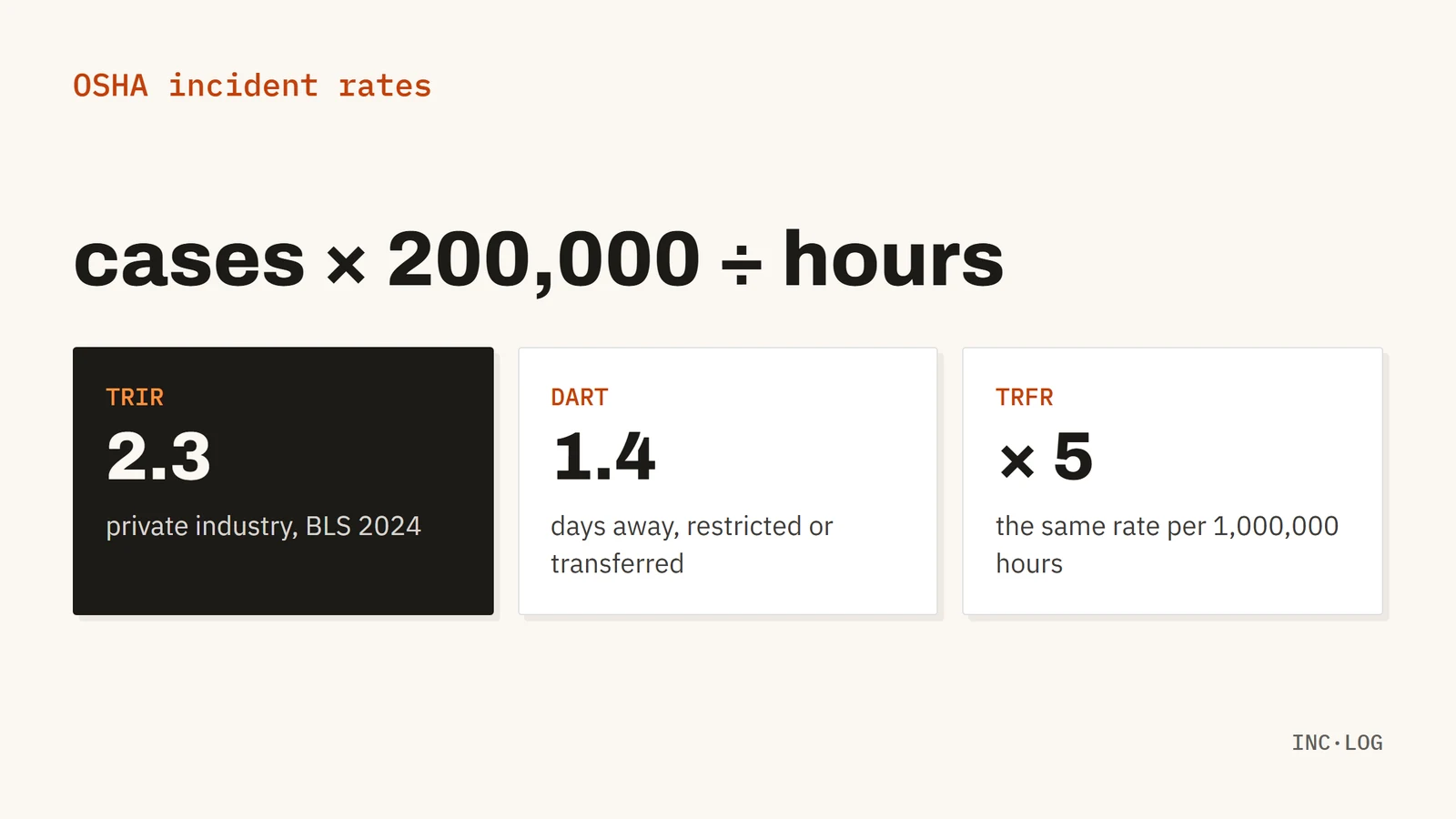
TRIR & DART Rate Calculator
Turn your OSHA 300A totals into TRIR, DART, LTIR and the international TRFR, and see how they compare with your industry's BLS average.
- Private-industry TRIR, BLS 2024
- 2.3
- Industry benchmarks
- 17
For owners, CFOs and risk managers
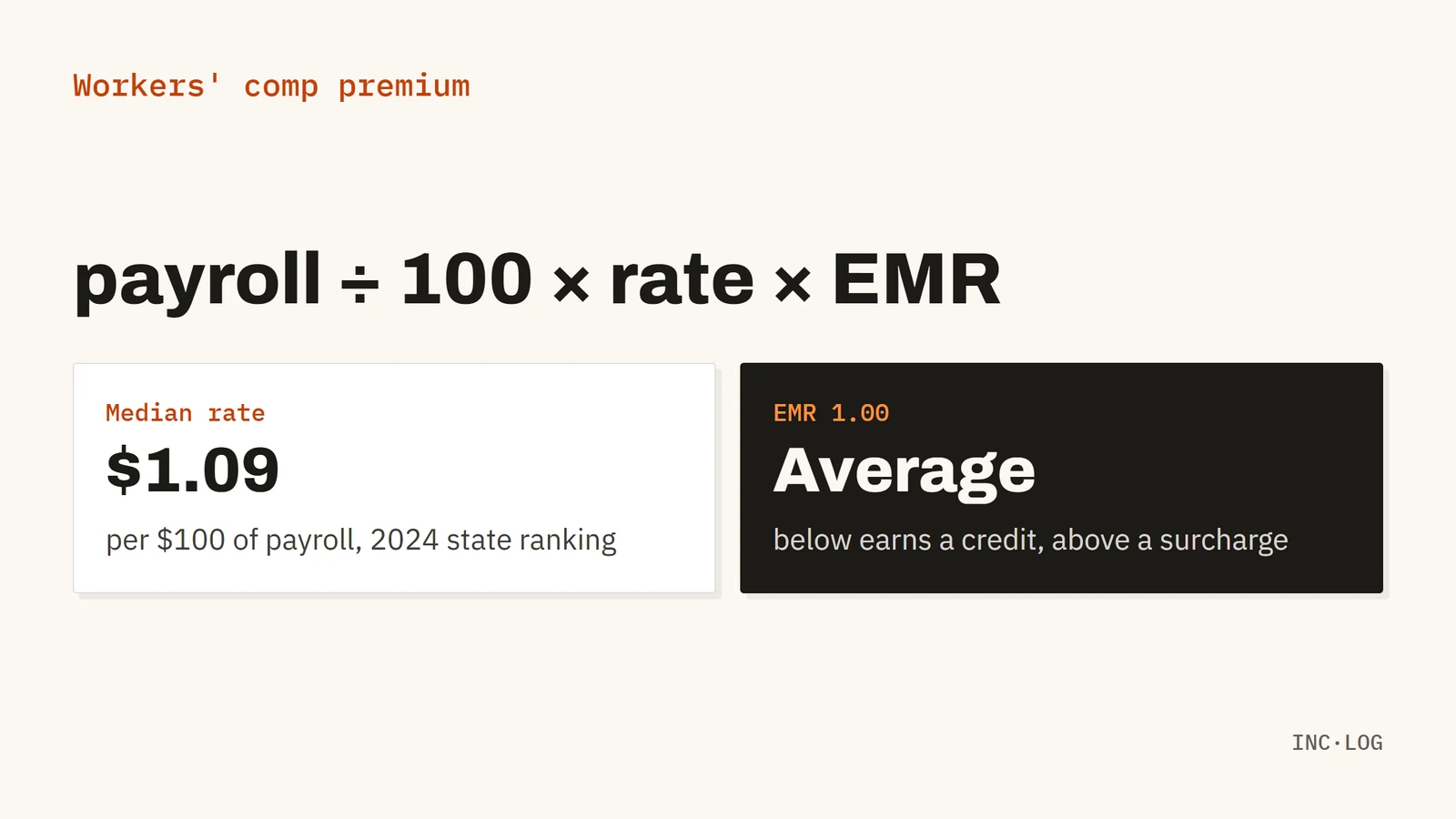
Workers' Comp Cost & EMR Calculator
Estimate your premium from payroll, class code and experience mod, and see what an EMR above or below 1.00 costs you each year.
- Median rate per $100 of payroll
- $1.09
- Jurisdictions with 2024 rates
- 51
For safety coordinators and HR
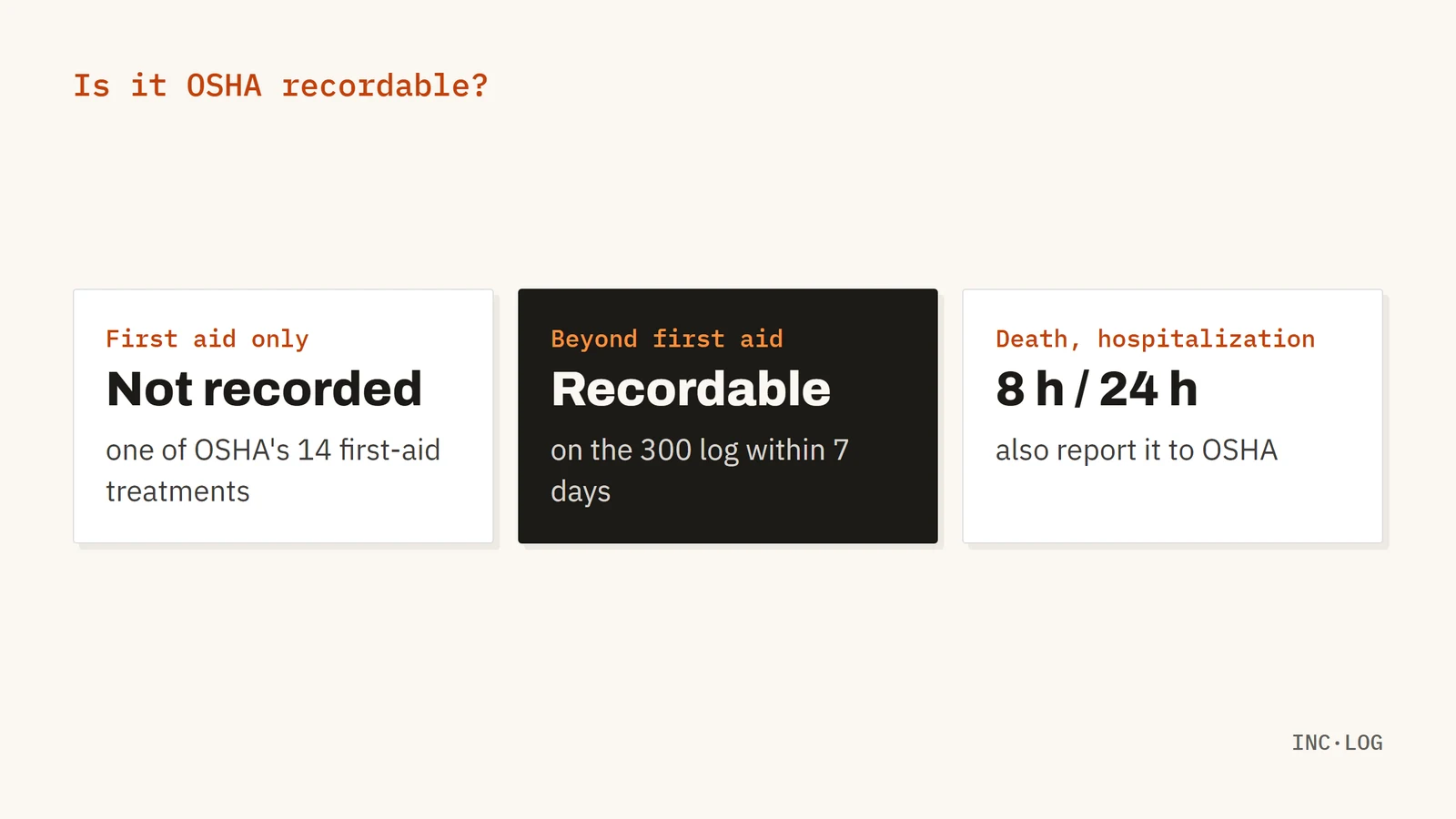
OSHA Recordable Injury Checker
Answer a few questions about an injury to see if it goes on the OSHA 300 log, which column to check, and whether OSHA needs a call within 8 or 24 hours.
- First-aid treatments, the full list
- 14
- Work-relatedness exceptions
- 9
The formulas, at a glance
What each tool calculates, and the benchmark it compares you with.
| Measure | Formula | Benchmark |
|---|---|---|
| TRIR | Recordable cases (300A columns H + I + J) × 200,000 ÷ hours worked | 2.3, private industry (BLS 2024) |
| DART rate | Cases with days away, restriction or transfer (H + I) × 200,000 ÷ hours | 1.4, private industry |
| LTIR | Days-away cases (H) × 200,000 ÷ hours | 0.8, private industry |
| TRFR | Recordable cases × 1,000,000 ÷ hours | TRIR × 5 |
| Workers' comp premium | Payroll ÷ 100 × class rate × EMR | $1.09 per $100, median state rate (2024) |
| OSHA recordable | Work-related, a new case, and beyond first aid (or days away, restriction, death...) | 14 first-aid treatments that don't count |
The short answers
- How do you calculate an OSHA incident rate?
- Multiply the number of recordable cases by 200,000 and divide by the total hours worked by all employees in the same period. The 200,000 stands for 100 full-time workers for a year, so the result is a rate per 100 workers. For the DART rate, count only cases with days away, restriction or transfer.
- What is a good TRIR?
- OSHA sets no pass mark. A good TRIR is at or below the Bureau of Labor Statistics average for your industry, and falling; in 2024 the average for all private industry was 2.3. Customers that prequalify contractors often set their own maximum.
- What is an experience modification rate (EMR)?
- It's the multiplier that adjusts your workers' comp premium to your own claims history. NCCI or your state's rating bureau compares your actual losses over three policy years with the losses expected for a business your size in your class codes: 1.00 is average, below 1.00 lowers your premium, above 1.00 raises it.
Where the numbers come from
- Incident rate benchmarks: Bureau of Labor Statistics, Survey of Occupational Injuries and Illnesses, 2024 data, private industry rates per 100 full-time workers.
- Workers' comp rates: Oregon Department of Consumer and Business Services, 2024 premium rate ranking, which prices the same mix of work in all 51 jurisdictions, from $0.50 per $100 of payroll in North Dakota to $2.52 in Hawaii.
- Formulas: the BLS incidence-rate method (cases × 200,000 ÷ hours worked) and the standard manual-premium × experience-mod calculation used by NCCI and state rating bureaus.
More free resources
- OSHA 300 and 300A forms: blank printable forms, and how to fill them in.
- OSHA 300 log requirements: the 300, 300A and 301, posting dates and electronic submission.
- Free incident report templates: PDF and Word files for 16 kinds of incidents.